Lima, Peru
6 - 14 August 2010
I lost an extra week in Lima that I just realised I never mentioned here. After visiting Cuzco I returned to Lima for what was to be a 2 night stay, an opportunity to say goodbye and do some last minute shopping before taking a flight to New York. As you can see from the dates above, an extra week was added to the 2 days.
In Lima, before and after Cuzco, I was privelged enough to be able to stay with friends in their house in Miraflores. Just 2 hours prior to my scheduled taxi pickup for the airport I returned to the house from souvenier shopping and had a terrible accident. I tripped over on concrete in the street outside the house and hit the front of my left leg. This leg had just about recovered from the bruising of the mototaxi accident in Iquitos and the same parts of the left leg were now hurting again, only it was incredibly more intensely painful this time. I couldn't stop crying. My pain was intense, I couldn't walk, an I had a flight to catch.
My friend came home and I was still crying and still stubbornly trying to prepare myself to fly (I really wanted to leave South America). She stubbornly told me I couldn't fly, that I needed to go to hospital. She was right. I had to admit it, there was no way I could fly. In leiu of my imminent flight, I called my travel insurance company first.
At the hospital they gave me a needle for the pain and took x-rays. The first doctor told us that I had cracked the cap of the bone, but that I would need to talk to a traumatoligist and that he was on his way. The traumatoligist didn't mention any crack (and I didn't think to ask) but just the contusion and gave me a prescription for more needles, painkiller tablets, and only to walk to go to the bathroom for 4 days. After 4
days I returned to get the all clear to fly and the traumatoligist (a different one), when I asked, said he couldn't see any crack in the x-rays, but that I had been in such pain because of where I had hit the
leg in the front. He said I could now fly, to walk but sit regularly for extended periods.
My travel insurance organized my replacement flight, and lucky for me it was direct.
I do want to make a comment about my wanting to leave South America. I was so disappointed that I couldn't fly that first Saturday, I had become what I didn't want to be.... Jaded. Often long term backpackers become this. So I wanted a change to a completely different place ... Somewhere that spoke English, had food I knew, had salad on the menu and safe salad, and toilet seats on toilets. My pain from the injury was intense, but I was also shedding tears because I wanted so much to go.
My friends and hosts in Lima made my staying so much easier of course ... I don't know how I could have coped alone in a hostel.
I am writing this 3.5 weeks later. Last night I still needed to take anti-inflamatories so it's not over yet. I guess I walked too much yesterday, and I tried swimming yesterday too. I hope that it's good in 4 weeks time, because plan A is to take tango classes in Buenas Aires.
Notes
My travel insurance is with World Nomads. They are definately worth considering if you are travelling long term, and maybe even for short term too. They have great prices and they will help on a lot of things via email... which is really useful while travelling. I just wish they had a Skype ID to call them on. They are international, not just for Aussies. www.worldnomads.com
Showing posts with label Peru. Show all posts
Showing posts with label Peru. Show all posts
Wednesday, 1 September 2010


Sunday, 8 August 2010
The Must do sites of Peru
Cuszo, Aguas Calientes, and Machu Picchu
27 July 2010 - 6 August 2010
The first time I came close to this part of the world, Machu Picchu was closed because of the flooding and landslides at the beginning of this year. I wasn't too sad, it was one of those sites I was going to do because everybody says you must, and it being closed was letting me off the hook.
Now I have been to this part of the world I can say yes, Cuzco is beautiful and Machu Picchu impressive. But we knew that, right?



Notes:
Accomodation Cusco: Incama hostel. loved it, great value hostel. friendly and clean! $11 for a dorm of 3 girls only (finaly girls only).
Accomodation Aguas Calientes: Angie S..... don't bother, what is offered is not delivered, We were quoted and shown a room with private bath, then switched to shared bath after we had paid and then they wanted us to pay to hire towels (not on my nellie!)
Dining Aguas Calientes: be sure to ask for exactly what you'll get and what it will cost in advance, otherwise they sneak things onto the bill. See a local tax on your bill? refuse to pay it!
Train: Backpacker Poroy (Cusco) to Aguas Calientes $48, Taxi to Poroy S/30 ($11). Vistadome (supposed better service) Aguas Calientes to Ollantaytambo (half way) $53 (no better seats, food a bit better). Collectivo Ollantaytambo to Cuzso S/10 ($3.50)
Bus Aguas Calientes to MachuPicchu and back $14.
Entry to MachuPicchu, student price S/.63 ($23)
Entry to 16 sites in and around Cusco, 10 day ticket, student price S/.70 ($25).
27 July 2010 - 6 August 2010
The first time I came close to this part of the world, Machu Picchu was closed because of the flooding and landslides at the beginning of this year. I wasn't too sad, it was one of those sites I was going to do because everybody says you must, and it being closed was letting me off the hook.
Now I have been to this part of the world I can say yes, Cuzco is beautiful and Machu Picchu impressive. But we knew that, right?

In Cuzco, by night

Saqsayhuaman (say it like 'sexy woman', you'll be close). Just outside of Cusco, and very impressive.

Saqsayhuaman has Inca slippery-slides!

A view.

My favourite wow site for the week (well I had less expectations of this, for MP I had too many expectations). this is Moray. They believe it was used for agricultural experimentation. The dots are young people rehearsing for a festival.

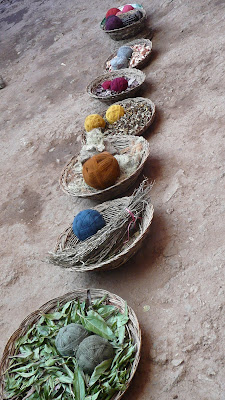
Natural dyes of Alpaca Wool.

And, incase you don't recognise it, MachuPicchu!
Notes:
Accomodation Cusco: Incama hostel. loved it, great value hostel. friendly and clean! $11 for a dorm of 3 girls only (finaly girls only).
Accomodation Aguas Calientes: Angie S..... don't bother, what is offered is not delivered, We were quoted and shown a room with private bath, then switched to shared bath after we had paid and then they wanted us to pay to hire towels (not on my nellie!)
Dining Aguas Calientes: be sure to ask for exactly what you'll get and what it will cost in advance, otherwise they sneak things onto the bill. See a local tax on your bill? refuse to pay it!
Train: Backpacker Poroy (Cusco) to Aguas Calientes $48, Taxi to Poroy S/30 ($11). Vistadome (supposed better service) Aguas Calientes to Ollantaytambo (half way) $53 (no better seats, food a bit better). Collectivo Ollantaytambo to Cuzso S/10 ($3.50)
Bus Aguas Calientes to MachuPicchu and back $14.
Entry to MachuPicchu, student price S/.63 ($23)
Entry to 16 sites in and around Cusco, 10 day ticket, student price S/.70 ($25).
Saturday, 7 August 2010
Peruvian Men still annoying me
Cuzco, Peru
27 July 2010 - 6 August 2010
My guide book (Footprints South American Handbook) spoke of a restaurant in Cusco that has items on it's menu utilizing only ingredientes available during the Inca times. I wanted to go, so in my first few days in Cusco I went to the restaurant to view the menu, and the waiter 'came onto me' so strongly that I didn't enter.
In Aguas Calientes, I became friends with a Brazilian backpacker, and on return to Cusco I convinced him to go to the restaurant with me. It was beautiful! The food lovely, and the service very special. And I loved the music! But being that we planned to go dancing afterwards and neither of us had bought our cameras, we needed to return the next day, during the day, for photos and because I wanted to buy their CD of music.
On return the next day we were treated to a special visit of a 'secret museum' they have upstairs. And while Marcelo (the Brazilian) was setting up his camera for a photo of us and 'the guide' (the same waiter), the guide couldn't help himself but to have his arm around me (for the photo) and be caressing my side. Arrgh! I never know what to do in these situations. I mean it seems harmless enough, a small annoyance, and I didn't want to ruin the experience by making things nasty.
Later Marcelo asked me if I thought we should have tipped for the special visit... I told him I thought not. Money was not the guides motivating factor.


Notes:
Inkanato Restaurant, Calle San Agustin 280, Cusco. Inca Food about $14 a plate. Great serving sizes, great decor, great atmosphere. But single girls, take a guy.
27 July 2010 - 6 August 2010
My guide book (Footprints South American Handbook) spoke of a restaurant in Cusco that has items on it's menu utilizing only ingredientes available during the Inca times. I wanted to go, so in my first few days in Cusco I went to the restaurant to view the menu, and the waiter 'came onto me' so strongly that I didn't enter.
In Aguas Calientes, I became friends with a Brazilian backpacker, and on return to Cusco I convinced him to go to the restaurant with me. It was beautiful! The food lovely, and the service very special. And I loved the music! But being that we planned to go dancing afterwards and neither of us had bought our cameras, we needed to return the next day, during the day, for photos and because I wanted to buy their CD of music.
On return the next day we were treated to a special visit of a 'secret museum' they have upstairs. And while Marcelo (the Brazilian) was setting up his camera for a photo of us and 'the guide' (the same waiter), the guide couldn't help himself but to have his arm around me (for the photo) and be caressing my side. Arrgh! I never know what to do in these situations. I mean it seems harmless enough, a small annoyance, and I didn't want to ruin the experience by making things nasty.
Later Marcelo asked me if I thought we should have tipped for the special visit... I told him I thought not. Money was not the guides motivating factor.

This is he. The special treat included him playing us the Inca instruments.

Doesn't look half as good in the photo.
Inkanato Restaurant, Calle San Agustin 280, Cusco. Inca Food about $14 a plate. Great serving sizes, great decor, great atmosphere. But single girls, take a guy.
Tuesday, 27 July 2010
Life in Iquitos Peru... the hard bed, mosquitos and dirt.
As mentioned in other posts, while I was volunteering at the manatee centre, I was lucky enough to be hosted by a Peruvian family. These people weren't rich, but they showed me tremendous generousity. The wouldn't let me pay for my keep and fed me two meals a day. I found that the best way for me to contribute was to head to the supermarket and buy food for the entire family. My purchases were limited, as they tend to shope daily, but by buying rice and sugar and such I'm sure I helped. When I left I bought a big hamper of groceries and left it with them on the very last day. They seemed delighted. These people usually buy for today... a cup of rice today, another tomorrow, what meat and vegetables are needed for today are bought today, and no more than two rolls of toilet paper at a time. Most dry goods were bought from the convenience store next store.
Living with them was very interesting. Had I been paying for accomodation I would have wanted something more comfortable and cleaner, but, I just reminded myself that many people successfully live like this (or worse) their entire lives, and these people seemed healthy enough. And I covered the bed with my hammock (thick cotton barrier), my sleeping bag (a little softness), and covered me with my silk sleep sheet (to keep the mosquitoes away). Even the cat realised my bedding was better, and I had daily fights with the cat who I would find spawled across my bed. There was no way of keeping the cat out.
The families generousity wan't just financial, they treated me well too and the mother said she would miss the only person who ever offered to wash up (and would then wash up) after a meal (peruvian culture seems to have their children not having to raise a finger, despite all 3 being over 15 years old). I hope I never have to sleep so uncomfortably for a whole month again unless the scenery is spectacular, but I really appreciate what they did for me. Overall it was a worthwhile experience.
Living with them was very interesting. Had I been paying for accomodation I would have wanted something more comfortable and cleaner, but, I just reminded myself that many people successfully live like this (or worse) their entire lives, and these people seemed healthy enough. And I covered the bed with my hammock (thick cotton barrier), my sleeping bag (a little softness), and covered me with my silk sleep sheet (to keep the mosquitoes away). Even the cat realised my bedding was better, and I had daily fights with the cat who I would find spawled across my bed. There was no way of keeping the cat out.
The families generousity wan't just financial, they treated me well too and the mother said she would miss the only person who ever offered to wash up (and would then wash up) after a meal (peruvian culture seems to have their children not having to raise a finger, despite all 3 being over 15 years old). I hope I never have to sleep so uncomfortably for a whole month again unless the scenery is spectacular, but I really appreciate what they did for me. Overall it was a worthwhile experience.
Saturday, 24 July 2010
Living in Iquitos
Iquitos, Amazon Jungle, Peru
Written whilst staying with Peruvian Iquitiarian family, but publish later to save chance of offending while I would have to deal with consequences.
I couldn´t cope anymore, after just a while of living with the local family I went and bought toilet cleaner, a brush, and gloves. And I scrubbed and scrubbed the toilet that may never had been cleaned in their many years of living in the house. It looked so much nicer afterwards.
I didn´t do it at first because I was worried about offending them, but the filth got too much and I decided it was worth the risk. Anyway, when the harpic toilet cleaner was advertised on the television and they all looked longily at the screen I thought hell, even they realise it 's dirty!
Written whilst staying with Peruvian Iquitiarian family, but publish later to save chance of offending while I would have to deal with consequences.
I couldn´t cope anymore, after just a while of living with the local family I went and bought toilet cleaner, a brush, and gloves. And I scrubbed and scrubbed the toilet that may never had been cleaned in their many years of living in the house. It looked so much nicer afterwards.
I didn´t do it at first because I was worried about offending them, but the filth got too much and I decided it was worth the risk. Anyway, when the harpic toilet cleaner was advertised on the television and they all looked longily at the screen I thought hell, even they realise it 's dirty!
Monday, 19 July 2010
Flirtations in Peru
Written 06 July, 2010, for later publishing.
I am beginning to wonder.... if, as a latina girl, you have a childhood of watching your father ogle other women and flirt when given the chance, then, when you grow up and get married and your husband does this, is it all ok? Does it make him all the more the good man, just like your Daddy? Men seem to ogle and flirt here no matter whose company they are in, hassling the blonde chica might be a kind of sport.
At work (volunteering in the Manatee project) I have had a dilema. On the weekend I realised that one of my work mates, engaged to another workmate, is cheating on her. I told her today... Ouch! But I realised that she was already fighting with him, didn´t fully trust him, and hadn´t worn the ring the last two days, so I asked her about that and she said they 'separated', so I thought, well, better now than later. And I would hate to see a friend marry a scum bag if I knew he was a scum bag and didn´t at least tell her. I like her, I didn´t like him from the start.... I tried to for her sake, but since Sunday I don´t feel the need to try anymore.
However, I do think that she is one of the most valuable parts of the project, so I also let the head boss know how fantastic she is. I hope she doesn't hate me!
Continued 18 July 2010... (I have left Iquitos now)
The above mentioned disclosure to my friend and workmate had a big affect on me. I was horrified to learn later that night and the next day that almost everybody else had known about the whole affair. They all felt bad about it, but wanted to say anything. What crappy friends! So, already sick and tired of being hassled by latinos, I now really feel that very few of them can be trusted with a heart, and so I just wanted to get away from them altogether and be someplace without latinos (the men this is... latino for guys, latina for gals). Two weeks later I have left Iquitos, but I am still in Peru. My feelings aren't quite as strong, but I still feel the need to get away.
A bonus for me did come out of it, one of my other work mates had continually told me that he always wanted a Gringa girlfriend and that (on hearing that I'm quite the dancer) than he'd like to go dancing with me, but just us, no one else... well, he stopped his suggestions as soon as I dobbed on the other guy. Whew! that was a relief.
In answer to all those who ask would I like to marry a latino... at this point they're looking like a bad option. (Aside from the fact that they mostly seem to be incredibly clucky).
I am beginning to wonder.... if, as a latina girl, you have a childhood of watching your father ogle other women and flirt when given the chance, then, when you grow up and get married and your husband does this, is it all ok? Does it make him all the more the good man, just like your Daddy? Men seem to ogle and flirt here no matter whose company they are in, hassling the blonde chica might be a kind of sport.
At work (volunteering in the Manatee project) I have had a dilema. On the weekend I realised that one of my work mates, engaged to another workmate, is cheating on her. I told her today... Ouch! But I realised that she was already fighting with him, didn´t fully trust him, and hadn´t worn the ring the last two days, so I asked her about that and she said they 'separated', so I thought, well, better now than later. And I would hate to see a friend marry a scum bag if I knew he was a scum bag and didn´t at least tell her. I like her, I didn´t like him from the start.... I tried to for her sake, but since Sunday I don´t feel the need to try anymore.
However, I do think that she is one of the most valuable parts of the project, so I also let the head boss know how fantastic she is. I hope she doesn't hate me!
Continued 18 July 2010... (I have left Iquitos now)
The above mentioned disclosure to my friend and workmate had a big affect on me. I was horrified to learn later that night and the next day that almost everybody else had known about the whole affair. They all felt bad about it, but wanted to say anything. What crappy friends! So, already sick and tired of being hassled by latinos, I now really feel that very few of them can be trusted with a heart, and so I just wanted to get away from them altogether and be someplace without latinos (the men this is... latino for guys, latina for gals). Two weeks later I have left Iquitos, but I am still in Peru. My feelings aren't quite as strong, but I still feel the need to get away.
A bonus for me did come out of it, one of my other work mates had continually told me that he always wanted a Gringa girlfriend and that (on hearing that I'm quite the dancer) than he'd like to go dancing with me, but just us, no one else... well, he stopped his suggestions as soon as I dobbed on the other guy. Whew! that was a relief.
In answer to all those who ask would I like to marry a latino... at this point they're looking like a bad option. (Aside from the fact that they mostly seem to be incredibly clucky).
Saturday, 17 July 2010
Working to save the Amazonian Manatee
Iquitos and around, Amazon Jungle, Peru
I spent a month volunteering at a Manatee Rescue project on the outskirts of Iquitos in the Amazon Jungle of Peru. My work there was to guide English speaking tourists and to assist the project in it's endevours to raise some funds to fund the education of the locals in regards to Manatee and general environmental conservation.
The centre basically does two things. It rescues and rehabilitates orphaned manatees for eventual release back into the wild. And secondly, it is educating the local communities about the need to protect these animals and to look after the environment in general. Because really, there isn't much point rescuing them if they remain a food source. So the second part is extremely important.
The centre has been operating just over 2 years, it currently has 12 Manatees and is expecting to release the oldest of these late this year.
The Manatee problem is that the local communities, if given the chance, will often kill an adult Manatee for food. It isn't considered good food, but, with adults reaching almost 3 metres and 450kgs, it is BIG food. That removes a valuable animal from the ecosystem, and often leaves a baby Manatee unprotected and without a source of milk. So, the locals take the calf with the idea of attracting tourists with it or selling it as a pet. Most of these calvesdie within months of being taken into captivity. They need milk for the first 2 years of their lives and cow's milk is too high in lactose. So they get malnutrition, colic, diarrhea, as well as perhaps suffering from a harpoon, machete or net wound from their initial capture. If they do survive, life is likely to be in bad conditions... small cages in the water, or in polluted unclean water.
The rescue centre (ACOBIA) often finds out about these captured calves through its aducation program. Last year they educated about 40,000 kids. Kids often like to do the right thing, and often when they learn about Manatees they tell the ACOBIA staff that they know where there is a Manatee... and in this way the Rescue staff can approach the community or people and request possession of the Manatee. Capturing and/or killing a manatee is illegal... but the locals mostly don't know that.
The education is mostly provided to Kids. They are more accessible in the schools and more willing to listen. It's not that they (ACOBIA) don't bother with adults, they'll tell anyone they can and while I was there I got to accompany staff on a trip upriver to give a presentation to fisherman. The presentation was about minimum catch sizes, fish farming as an alternative, and the protection and value of Manatees and Dophins in the Ecosystem.
The Amazonian Manatees are threatened with extinction. These defenseless creatures have only humans to blame for this. They are rarely taken by any other animals because they are just too big, and they live in the water. The locals are being taught to understand that they have to take care of the environment, or there won't be anything left for their children to eat. Take the Manatees from the ecosytem and you might have too many aquatic plants, these starve the water from Oxygen, and then fish die. Also, adult Manatees contain a lot of mercury, and this isn't good for human consumption.
I hope that ACOBIA can continue in its success. The Rescue side of things is funded by the Dallas World Aquarium, and with my help they are now poised to make more money from tourists visiting the site and the new website (still being constructed).The money will assist in providing education to yet more people, and in the future the plan is to incorporate a lot more general conservation message into their talks.
The center can be visited free of charge and I highly recommend it. You might even get to touch a Manatee! It is on the way to Quistococha, Take a Mototaxi or Collective 49 directly, or any collective bus to the terminal and than a collectivo mototaxi headed to Quistococha. Ask to stop at IIAP Carretera.
The new website is http://www.acobia-dwazoo.org/ .
Education onsite


Trip to educate fisherman in a Riverside town.


I spent a month volunteering at a Manatee Rescue project on the outskirts of Iquitos in the Amazon Jungle of Peru. My work there was to guide English speaking tourists and to assist the project in it's endevours to raise some funds to fund the education of the locals in regards to Manatee and general environmental conservation.
The centre basically does two things. It rescues and rehabilitates orphaned manatees for eventual release back into the wild. And secondly, it is educating the local communities about the need to protect these animals and to look after the environment in general. Because really, there isn't much point rescuing them if they remain a food source. So the second part is extremely important.
The centre has been operating just over 2 years, it currently has 12 Manatees and is expecting to release the oldest of these late this year.
The Manatee problem is that the local communities, if given the chance, will often kill an adult Manatee for food. It isn't considered good food, but, with adults reaching almost 3 metres and 450kgs, it is BIG food. That removes a valuable animal from the ecosystem, and often leaves a baby Manatee unprotected and without a source of milk. So, the locals take the calf with the idea of attracting tourists with it or selling it as a pet. Most of these calvesdie within months of being taken into captivity. They need milk for the first 2 years of their lives and cow's milk is too high in lactose. So they get malnutrition, colic, diarrhea, as well as perhaps suffering from a harpoon, machete or net wound from their initial capture. If they do survive, life is likely to be in bad conditions... small cages in the water, or in polluted unclean water.
The rescue centre (ACOBIA) often finds out about these captured calves through its aducation program. Last year they educated about 40,000 kids. Kids often like to do the right thing, and often when they learn about Manatees they tell the ACOBIA staff that they know where there is a Manatee... and in this way the Rescue staff can approach the community or people and request possession of the Manatee. Capturing and/or killing a manatee is illegal... but the locals mostly don't know that.
The education is mostly provided to Kids. They are more accessible in the schools and more willing to listen. It's not that they (ACOBIA) don't bother with adults, they'll tell anyone they can and while I was there I got to accompany staff on a trip upriver to give a presentation to fisherman. The presentation was about minimum catch sizes, fish farming as an alternative, and the protection and value of Manatees and Dophins in the Ecosystem.
The Amazonian Manatees are threatened with extinction. These defenseless creatures have only humans to blame for this. They are rarely taken by any other animals because they are just too big, and they live in the water. The locals are being taught to understand that they have to take care of the environment, or there won't be anything left for their children to eat. Take the Manatees from the ecosytem and you might have too many aquatic plants, these starve the water from Oxygen, and then fish die. Also, adult Manatees contain a lot of mercury, and this isn't good for human consumption.
I hope that ACOBIA can continue in its success. The Rescue side of things is funded by the Dallas World Aquarium, and with my help they are now poised to make more money from tourists visiting the site and the new website (still being constructed).The money will assist in providing education to yet more people, and in the future the plan is to incorporate a lot more general conservation message into their talks.
The center can be visited free of charge and I highly recommend it. You might even get to touch a Manatee! It is on the way to Quistococha, Take a Mototaxi or Collective 49 directly, or any collective bus to the terminal and than a collectivo mototaxi headed to Quistococha. Ask to stop at IIAP Carretera.
The new website is http://www.acobia-dwazoo.org/ .
Education onsite

Education is given at the centre and externally in the communities. At the centre you might get the chance to help feed them. Second from left is staff member Darwin.

A group of school children visiting the centre.
Trip to educate fisherman in a Riverside town.

On my "Business trip" to Requena, BYO hammock, as usual, as well as a mobile internet connection if you want to work whilst in transit.

Kelly talks to the fisherman about protecting the Manatees. She was congratulated for giving a speach that was clear and easy to comprehend. Remember these are fisherman, doing the best they can to feed their families today, and being taught to think about their childrens families in the future.

Requena has about 40,000 people. I thought it was rather picturesque.

I had to grab this photo! They seemed to be heading home for the day. In Requena.
Trip to educate kids in riverside communities

Breakfast on day 1, whilst waiting for the boat to depart.

Yarapa River Lodge is a tourist lodge with wonderful facilities, it supports the education of 4 local communities that live nearby.

Going to invite a community of school children to come to our 'show'. Andy (I call him Squeegee, they call him something similar I couldn't pronounce), Joy, me, and Christian.

One of the advantages of being a Gringa.... the Gringa tourists invited me on their morning riverboat birdwatching tour. I saw wild Scarlett Macaws and lots lots more.

Here come the kids. The lodge gives them breakfast (it encourages attendance and concentration), and provides a space.

Learning about the environment is clearly fun.

We had a puppet show. This is Pablito, a tourist who likes to see the environment looking healthy and without rubbish.

Then we drew pictures... well I just watched and encouraged. I couldn't begin to think how to draw a monkey.

Actually I drew the river and the tree.
Sunday, 11 July 2010
Battered and Bruised in Peru... again
Iquitos, Amazon Jungle, Peru
What rotten timing! I have been in Iquitos 4 weeks and in that time I have been helping out at the Manatee centre and haven´t been doing a lot, physically speaking. So, tomorrow I am off to the jungle with work mates, and this morning me and a friend were in a ´car accident´. I put car in inverted commas because we were in a Mototaxi or MotoKar (like a Tuk-Tuk).
It all happened so fast. Ruud (dutch friend) and I were just chatting, suddenly Ruud yells 'whoa! watch out', and then we slam into the back of a SUV. I couldn´t move at first, I had fallen forward, my right leg had slipped down and I had landed with my bum on the floor of the Tuk-tuk, one leg down and the other leg, well, I´m not sure where it went, but it has a lot of swelling and pain now.
The police arrived amazingly fast for a country that does everything ´manaña´, and they insisted that we go to the hospital, although what we both wanted to do was sit and get to feeling right. I felt like fainting, and when I looked at Ruud there was blood and he was sweating profusely. We were sure we had nothing more than surface wounds and bruising but we agreed to go to the hospital.
They checked us over, and all was ok, although I was insistant on some ice. The mototaxi driver had a cut over his eye and they were telling him he had to pay the emergency hospital bill for us and himself. He couldn´t afford the $2 for himself, let alone us, and so we paid our bills and his. (Yes that´s right $2! A total of $6 for the 3 of us! I won´t be needing to use my insurance). This poor man now has a police fine, and a bike to fix (although he should have been looking where he was going), and he needs this bike to make money. Although he was at fault, we knew that to pay for him was the only thing to do.
Then we got the most comfortable ride in Iquitos, in the police car to our intended destination. And I have a 7am start tomorrow to go limping into the jungle with work mates.
What rotten timing! I have been in Iquitos 4 weeks and in that time I have been helping out at the Manatee centre and haven´t been doing a lot, physically speaking. So, tomorrow I am off to the jungle with work mates, and this morning me and a friend were in a ´car accident´. I put car in inverted commas because we were in a Mototaxi or MotoKar (like a Tuk-Tuk).
It all happened so fast. Ruud (dutch friend) and I were just chatting, suddenly Ruud yells 'whoa! watch out', and then we slam into the back of a SUV. I couldn´t move at first, I had fallen forward, my right leg had slipped down and I had landed with my bum on the floor of the Tuk-tuk, one leg down and the other leg, well, I´m not sure where it went, but it has a lot of swelling and pain now.
The police arrived amazingly fast for a country that does everything ´manaña´, and they insisted that we go to the hospital, although what we both wanted to do was sit and get to feeling right. I felt like fainting, and when I looked at Ruud there was blood and he was sweating profusely. We were sure we had nothing more than surface wounds and bruising but we agreed to go to the hospital.
They checked us over, and all was ok, although I was insistant on some ice. The mototaxi driver had a cut over his eye and they were telling him he had to pay the emergency hospital bill for us and himself. He couldn´t afford the $2 for himself, let alone us, and so we paid our bills and his. (Yes that´s right $2! A total of $6 for the 3 of us! I won´t be needing to use my insurance). This poor man now has a police fine, and a bike to fix (although he should have been looking where he was going), and he needs this bike to make money. Although he was at fault, we knew that to pay for him was the only thing to do.
Then we got the most comfortable ride in Iquitos, in the police car to our intended destination. And I have a 7am start tomorrow to go limping into the jungle with work mates.
Saturday, 10 July 2010
Living in Iquitos, Amazon Jungle, Peru.
The Jungle has lots of new fruit to try and the names are confusing because often they are just regional names, not really Spanish. The locals don´t eat much fruit, they eat mostly rice and meat, and the they mix fruits with water and suger to make a drink. I like to eat fruits though.

The locals call this a Caimito. Online I found it is called a Abiu, or Yellow Star Apple. The botanical name is Pouteria Caimito. It´s sweet, and I really like it but sometimes people don´t like it because it is sticky like glue on your lips.
Half of 3 score and 10
Well I made it! To 35 that is. And for those who didn´t already know, a score is 20, so 35 is half of 3 score and 10, the allotted span of men.
I used to always think I would probably die sometime in my early 30's. It seems that it didn't happen, so I guess I'll probably live to a really ripe old age.
I´m not disappointed, as I am completely content with my life, but the idea (of dying) never really worried me either. Travelling like this you get so many occasions on which you might get killed, but I am amazingly calm about the whole thing. I figure, as I travel on the back of a motorbike with bald tyres, a driver sending text messages and another girl behind me, that there is really very little I can do about it and Que sera sera (it means, what will be will be). And I think that one can be content to die if they know that they have been living the life they are happy with and have been doing good to others as well.
I was nice that I had been here in Iquitos for almost a month prior to having my birthday, it meant that my work mates got me a birthday cake and my host family did too (so I have been eating a lot of cake). So, it wasn't a patch on last years celebration with all my friends back home, but it certainly was a treat.

I used to always think I would probably die sometime in my early 30's. It seems that it didn't happen, so I guess I'll probably live to a really ripe old age.
I´m not disappointed, as I am completely content with my life, but the idea (of dying) never really worried me either. Travelling like this you get so many occasions on which you might get killed, but I am amazingly calm about the whole thing. I figure, as I travel on the back of a motorbike with bald tyres, a driver sending text messages and another girl behind me, that there is really very little I can do about it and Que sera sera (it means, what will be will be). And I think that one can be content to die if they know that they have been living the life they are happy with and have been doing good to others as well.
I was nice that I had been here in Iquitos for almost a month prior to having my birthday, it meant that my work mates got me a birthday cake and my host family did too (so I have been eating a lot of cake). So, it wasn't a patch on last years celebration with all my friends back home, but it certainly was a treat.

Blowing out my candle, with my host mum Delicia proudly looking on.
Wednesday, 7 July 2010
Living in Iquitos
I have heard that the Biologists at the manatee project earn S/.600 per month, that's about $US210, and this is a typical salary. To us, it isn´t a lot.
Last week coming back on a river boat from a community workshop I attended I bought about 300g of Fresh Cheese for S/.10 (about $US3.50). At first I thought that it wasn´t much of a contribution to the house where I am staying, but then I realised that it really was a reasonable treat to bring home. This cheese is a popular item to buy on this trip, but at this price, considering the salaries, it really must be considered a luxury.
Last week coming back on a river boat from a community workshop I attended I bought about 300g of Fresh Cheese for S/.10 (about $US3.50). At first I thought that it wasn´t much of a contribution to the house where I am staying, but then I realised that it really was a reasonable treat to bring home. This cheese is a popular item to buy on this trip, but at this price, considering the salaries, it really must be considered a luxury.
Monday, 5 July 2010
Sightseeing in Iquitos
Belem, Part of Iquitos, Amazon Jungle Peru.
Belem is one of the poorest parts of Iquitos. Land costs money, but building your house above the river doesn't cost for land, just the materials.


Belem is one of the poorest parts of Iquitos. Land costs money, but building your house above the river doesn't cost for land, just the materials.

From a distance, Belem doesn´t appear too bad.

Turtles are endangered, but you´ll find them and other endanger species for sale in the Belem market. People are hungry, the hunter has mouths to feed, so does the vender, and so does the purchaser. In the case of Manatee (remember I am working in a Manatee rescue centre) the meat sells for just S/.1 ($US0.35) per kg. It´s not considered good eating, but, like I said, there are mouths to feed.

Most of Belem has water underneath it for part of the year, some of it for all of the year. Walking in this part is a balancing act, on random scraps of wood slimmed with mud.

The toilets will float when the water is high, then the waste goes directly into the river instead of onto the ground. Yuck!

These people have there toilet in a permanently floating location, it is shared between several houses. These houses are pretty cute.

Floating houses. They tie them to the long sticks to stop them floating away.

Nice, the got a footpath here. But it too will go under water and the houses will rise with the water.
Notes
Boat trip in Belem, about 40 minutes. S/.10- S/.15 ($US3.50-$5)
Thursday, 1 July 2010
Flirtations in Peru
My typical conversation with a MotoTaxi driver goes something like this. Mostly it is in Spanish, sometimes English. My part is in italics.
Where are you from? Australia.
How many children do you have? I don´t have any children.
Oh, you´re single? Yes (but thinking I should learn to lie)
Why? Because I want to travel and therefore need a man who wants to travel and can travel.
I want to travel, what is your phone number? I don´t have a phone.
Oh, then I will visit you, where are you staying? I´m sorry, but that's not a good question to ask.
But how will I see you again? Hmmm
Anyway, you need to be able to travel too. Hmmm
Are there many other Latinos in Australia? So, I guess you aren´t so interested in travelling. Oh look, we are here, goodbye.
Where are you from? Australia.
How many children do you have? I don´t have any children.
Oh, you´re single? Yes (but thinking I should learn to lie)
Why? Because I want to travel and therefore need a man who wants to travel and can travel.
I want to travel, what is your phone number? I don´t have a phone.
Oh, then I will visit you, where are you staying? I´m sorry, but that's not a good question to ask.
But how will I see you again? Hmmm
Anyway, you need to be able to travel too. Hmmm
Are there many other Latinos in Australia? So, I guess you aren´t so interested in travelling. Oh look, we are here, goodbye.
Saturday, 26 June 2010
Living in the Amazon Jungle in Iquitos, Peru
One of the young guys who helps out at the Manatee Rescue Centre kindly offered that I could stay with his family since his brother is away (studying) and his room was therefore available. So that´s where I am staying while volunteering there. It is very handy in that he goes there most days and a couple of other people who work at the centre live across the road. So mostly there is someone to travel with.
This is a good thing since it takes a hour or more each day to get to the centre. It´s out of town, and we are all on the other side of town. Not that I mind, it´s cheap and there are always things to look at.
The main forms of transport are personal motorbikes (for those who have them), mototaxi´s (the Peruvian form of the Thai tuk-tuk), and the Collectivo buses (so cute and constructed right here in the jungle).

The 'Collectivos', the bus part is built here in the Amazon at Iquitos. They are really cute, a bit like something my step grandfather would have constructed in miniture from leftover bits and pieces. The windows are extra cute. One day Alex (my host, the guy in the very left corner of the picture) told me to close the bus window as it was raining. I hadn't thought that they had windows... but he showed me that if you folded the hinged wooden sill back, you could pull up a loose perspex window from below and then put the sill back for the window to rest on. Cute!

Mototaxis galore. Apparently they are a Peruvian design. They chop a motorbike, extend the wheelbase, put a long axle on it and, well you can see the rest. Obviously we underestimated the power of the 110cc motorbike, I have seen these carrying 6 people!
Notes
1 hour in Collectivo 35c per person. Trip to work (collectivo bus with collectivo taxi for final part) 70c.
1 hour in Matotaxi with 3 friends (they really only seat 3 people, but this is Peru!) $3.50
Monday, 21 June 2010
Staying a while in the Amazon
Iquitos, Amazon Jungle, Peru
Now
Last time I was in the Amazon (in Bolivia) I liked it so much I wanted to stay, but I had no reason to and I wasn't ready to stop and my Bolivia Visa (already extended) was going to expire. This time, in Iquitos (Peru), I found a reason to stay.
I fell in love on my very first day in Iquitos, and decided to see if I could stick around. That first afternoon, while other tourists were watching the FIFA World Cup, I went out to a Manatee rescue project for a look. I found it very interesting, the staff very nice, and I immediately asked if they would like a volunteer. I was given an email address for the boss.
I wrote to the boss that same afternoon. I was able to put in that I actually wrote an essay about Dugongs whilst at University a year ago (I did 6 months of University (B Sc) before deciding I'd rather be travelling). It might have helped.But what they seem to be finding is more of a help from me is my Marketing experience. I'm good at making money, and they need this more than another Biologist. They need to educate the locals to stop killing the Manatees and this educating them takes money and resources.
This was my first week and I also got to attend a workshop to make an action plan to save the Manatees and River Dolphins. I actually got to have my say on what needs to be done, and they thanked me for my valuable input.

Can you see why I fell in love? This is Victoria.

The 3 in this area get hand fed by tourists.... bottled milk, aquatic plants, and bananas.
Amazon River Life
p Whilst taking the boat up the Amazon River from Leticia to Iquitos, being able to view a little of the lives of the people living on it´s banks made the biggest impression on me. Firstly, there are lots of people living there that the boat staff refered to as 'Isrealites'. The men had beards (very uncommon in Latin America) and the women wore head scarves. They otherwise appeared to be Latinos. In Caballo Cocha I got off the boat and asked one of the bearded mean what it meant to be an 'Isrealite'. The most important bit I got from him was that they believe that when one dies their spirit goes to another, and this also happened with Jesus and his spirit went to another who now lives on the banks of the Amazon. And with this they believe that the Amazon River is very important and cleansing.
Does this explain why they all throw their rubbish into the Amazon? I guess then it´s not their problem... the rubbish flows to elsewhere. It bothered Julian and I when we saw boat staff emptying boat rubbish into the Amazon, so we got plastic bags and kept our rubbish until we got to Iquitos.Another thing that amazed me was this-

The large white block is Ice. At about 60 x 30 x 15cms it can´t be light. The boy (I asked him) is 10 years old. He boarded the boat and added his ice to a stack of ice blocks. 5 hours later he disembarked with the ice and headed past the shacks (resting as he passed one) and continued, with ice, into the Jungle. This picture also shows an example of the head scarves of the 'Isrealite' women.
Friday, 18 June 2010
Rain on the Amazon River (continued)
Leticia, Colombian Amazon
5-9 June 2010
River Cargo and Passenger Boat Leticia (Colombia) to Iquitos (Peru)
9-12 June 2010
Iquitos, Peru
12 June - now
These photos are from the journey up the river from Santa Rosa (Leticia) to Iquitos. I met Julian in Iquitos and he was going the same direction so, being that the boats are known for theft and digestive problems (from the food), we teamed up to share the burden of looking after things and us. We didn´t have any problems and found the trip really cruizy. Julian was also great company.

First glimpseof the boat Julian and I thought it looked pretty rough, but we soon learnt it was one of the better ones.

Logging from the Amazon.

Julian and I arrived in Santa Rosa to board the boat while it was there, but it hadn't finished it's previous journey. It had to still go down to Icelandia (spelling might be wrong) to drop more passengers off and then back again to Santa Rosa to load up. But they let us on and come for the ride anyway. By doing this we made friends with the crew. Barman Francisco was continually nice to us, shouting me soda´s (like this bimbo).

The first morning the boat stopped at Caballo Cocha and Francisco went ashore to buy special fish from the area, which he then cooked for the staff and for Julian and I. It´s a bottom feeder, so rather muddy, but quiet tasty.

The boat is 2 floors of hammocks and 1 floor of cargo. Passage, including meals for the 3 nights, 2 days, was about $25.

Everyone has to buy their own hammock... Julian bought a cheapie for $11, I bought a pretty one that was bigger (to lie diagonally, as I heard it was the trick) for $15.

One of many towns along the Amazon.

The front view of our boat, the Gran Diego. From those from balconies I saw many grey river dolphins and just one pink one.

Church in Caballo Coche.

Locals meeting on the river edge.

One on the larger towns on the river, Veras. The third from the left is for sale. River views I guess, sometimes with the river right underneath.

Note the dunny (toilet), dumps right into the river or onto the ground, depending on the season. This is still in Veras.

Rainbow over the Amazon.
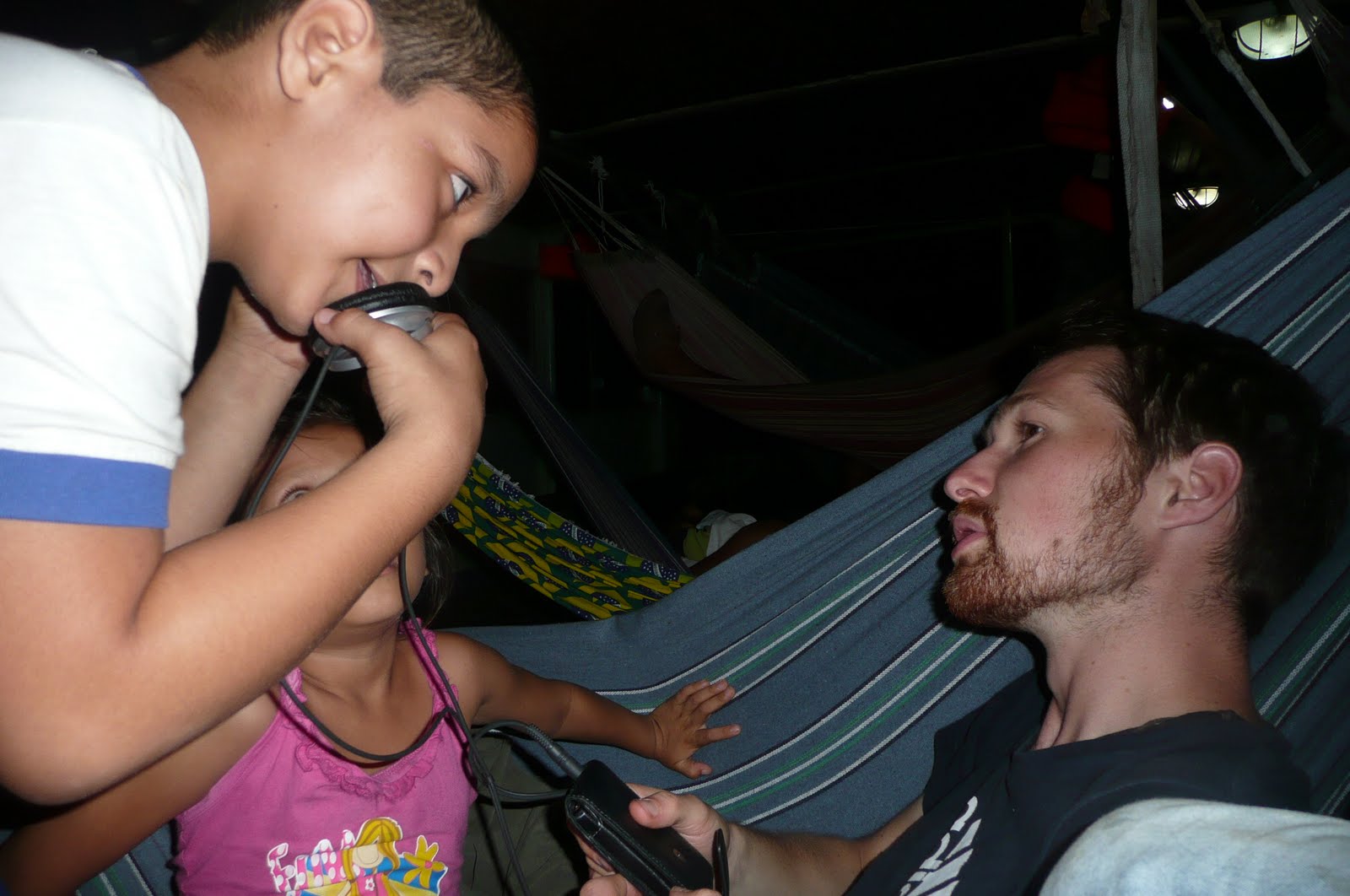
Julian entertaining kids on the boat (Valentine and Stephanie) by getting them to communicate with Aliens using his special equipment.
 ´
´There goes the Amazon Jungle.
Subscribe to:
Posts (Atom)